Monday, July 9, 2012

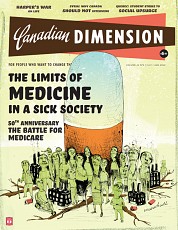
Canadian Dimension: The Limits of Medicine in a Sick Society

Canadian Dimension magazine
July/August 2012:
Volume 46, Issue 4

Medicare was born in conflict. The notorious Saskatchewan Doctors’ Strike aimed to abort it. That was 50 years ago. This issue of Dimension offers an historical perspective on that birth with an essay by Lorne Brown and Doug Taylor (who are preparing a book on the 50th anniversary of Medicare.) Ulli Diemer exposes “Ten Myths about Medicare,” and health economist Robert Chernomas discusses one of those myths in detail: the controversial sustainability question.

But this issue is about more than Medicare. It’s about the limits of medicine in an ailing and toxic society. Broadcaster and social commentator Jill Eisen writes about poverty and other social determinants of health. David R. Boyd, one of Canada’s leading experts in environmental law and policy, looks at the impact of environmental hazards on human health. Finally, Richard Barnet, himself a medical doctor, reflects on the radical views of Ivan Illich, who saw modern medicine as invading daily life in dangerous and disabling ways.

Click HERE.

Saturday, July 7, 2012

Tommy Douglas stamp commemorates universal medicare


 Saturday, July 07, 2012 1:30 PM

Former Saskatchewan premier Tommy Douglas’ picture put on stamp to honour universal medicare in Canada.
Photo Credit: Canada Post , Supplied
Canada Post has issued a stamp to honour former Saskatchewan premier Tommy Douglas, the father of universal medicare in Canada.
The stamp marks the 50th anniversary of the passing of Saskatchewan's 1962 Medical Care Insurance Act.
Douglas was the leader of the first socialist government in North America.
In 1947 Douglas introduced universal hospitalization in Saskatchewan and in 1959 announced a Medicare plan for people in the province.

Wednesday, July 4, 2012

Grateful for medicare

BY PAMELA COWAN
LEADER-POST 
JULY 4, 2012
 Todd Richter holds up a photo of himself as a young boy and it is believed he may be the first baby born in Saskatchewan under medicare. (TROY FLEECE / Regina Leader-Post)

Medicare is near and dear to Todd Richter’s heart.

The 50th anniversary of the Saskatchewan Medical Care Insurance Act on July 1 marked the Regina man’s 50th birthday.

Richter’s mother recalls giving birth to him at 12:02 a.m., so conceivably he was the first of 73 babies born in the province on the day that socialized medicine was delivered in Saskatchewan — a Canadian first.

Ahead of her due date, Arlene Richter was admitted to the Grey Nuns Hospital, now the Pasqua Hospital.

“I went in early because I was worried like everybody else was,” said the Regina woman.

July 1 marked the beginning of tumultous times in Saskatchewan’s health-care history. Many residents worried about what medical services would be available when the Saskatchewan Medical Care Insurance Act came into effect. Protesting the move to medicare, many doctors closed their office practice. Arlene’s physician refused to provide hospital services.

“I knew ahead of time that he wasn’t going to be there for (the delivery),” she said.

Induced on June 30, she gave birth to her third child shortly after the clock struck midnight. So began a new life and a new form of health-care in the province.

“It was two minutes after twelve and the doctor said, ‘Congratulations, you have had the first baby born under medicare’ — I’m not sure if that’s true or not because we’ve never been able to check it,” Arlene said.

Being one of the first children born under medicare never meant much to Richter until he hit middle age.

“I don’t know what I’d do without medicare,” he said. “After I turned 40, my body started to fall apart.”

He had surgery on his left knee in 2006 and two years later required an operation on his right knee. In 2009, he needed lower back surgery, which was followed by open heart surgery in 2011.

“My heart procedure involved the replacement of my aortic valve with a mechanical device and an aortic graft,” Richter said. “Now I feel like a million bucks — better than ever and not bankrupt thanks to medicare ... I’ve Googled the cost of the heart surgery and in various parts of the world, it varies from $250,000 to $300,000.”

His experiences with Saskatchewan’s health-care system have been “second-to-none.”

“I waited quite a while to get my knees done and I was on a waiting list for a little while for my back, but then I went on an emergency list and I got in right away,” Richter said.

His heart surgery was extremely speedy.

“When it’s life threatening, you’re in and out as quick as they can get you in and out,” Richter said. “All of the surgeries were 100-per-cent successful and I’m like a new person now and it didn’t cost me a dime out of my pocket ... Needless to say, I am very grateful and appreciative of the health-care system we have in this fine province of ours.

Saskatoon community clinic marks 50 years

By Jeremy Warren
The StarPhoenix
July 4, 2012

People tour the Saskatoon Community Clinic. The small group of doctors and citizens established the member-owned clinic in 1962 and started seeing patients on July 3 of that year. On Tuesday, the clinic hosted a 50th anniversary event. Photograph by: Gord Waldner, StarPhoenix , The StarPhoenix

Fifty years ago this week the Saskatoon Community Clinic welcomed its first patients as hundreds of doctors across Saskatchewan went on strike to protest the province's new medicare plan.

A small group of doctors and citizens established the member-owned clinic in 1962 and started seeing patients on July 3 of that year. On Tuesday, the clinic hosted a 50th anniversary event to commemorate the opening and the people and places that played a role in its creation.

Bonnie Lawrence's parents were among the clinic's first supporters and patients, but she was too young at the time to understand the emotional debates going on around her. On Tuesday, she joined a walking tour organized by the clinic to visit the historical sites connected to those early battles.

Medicare must not be taken for granted

By Pat Atkinson
The StarPhoenix 
Roy Atkinson
July 4, 2012

Medicare is synonymous with our Canadian identity. It has been so successful that we often take it for granted.

In Saskatchewan there are many whose lives have been shaped by the fight for universal access to health care.

Fifty years ago, in the summer of 1962, I was living on the family farm west of Biggar. As a nine-year-old I was hardly aware of the political drama that was being played out across the province, but knew something "important" was happening.

In a sense our farm was at the epicentre of that debate, given that the Biggar constituency was represented by premier Woodrow Lloyd, who had just implemented Canada's first universal medicare program on July 1.

Most doctors in Saskatchewan were vehemently opposed to medicare and wanted to continue to be paid by their patients. They did not want the "government" to pay them for their services and so began a 23-day strike.

Monday, July 2, 2012

Roy Romanow: Medicare is part of us

Health care is fundamentally intertwined with Canada's values and future 

By Roy Romanow
Globe and Mail
July 2, 2012

July 1, the birthdate of our great nation, is also the birthdate of Canada's emblematic health-care system. And this weekend we celebrated the 50th anniversary of the introduction of medicare in Saskatchewan. Now often referred to as unsustainable, this milestone provides an opportunity to reflect on the hard fought accomplishments of the past, to re-evaluate today's system and to consider the growing debate about its future.

Until 50 years ago, Canada's health-care system was based on the private, for-profit model. Patients individually paid for the services of medical professionals and hospitals. Often, those who could not afford health care did not receive it, and even some who could did so by deferring treatment, hoping to save their family budget. Since then we have built a national system, lauded around the world, that allows us all access to high-quality care.

The achievement of universal health care took a long, acrimonious and protracted road. It is no surprise to me that Saskatchewan was at the forefront of this journey. The province's citizens learned many hard lessons during the desperation of the Great Depression and the sacrifices of the Second World War. They learned about generosity, about hardship and fairness, about boom and bust. They learned about the imperative for co-operative action. They came to understand that the notion of shared destiny was key to our existence.

Sunday, July 1, 2012

Standing on guard for medicare

Federal lack of support strikes at system's heart

By Maude Barlow And Linda Silas
June 30, 2012

Fifty years ago on Canada Day, Saskatchewan passed the Medical Care Insurance Act, under the leadership of Tommy Douglas. This bold move birthed medicare and helped shape the Canadian identity. The passage of medicare federally four years later did for Canada what the national railway did almost a century before. It helped define us from coast to coast.

When Canadians are asked what institutions make them proud of their country, health care is consistently No. 1. No wonder Douglas beat out Don Cherry and Wayne Gretzky, among others, to be named CBC's Greatest Canadian because of his role in the creation of medicare. To this day, it is hockey, weather and medicare that dominate national conversations.

The debate on medicare is as old as medicare itself. Douglas warned Canadians to be vigilant because there will always be people who claim we can't afford it. As the argument goes, if we can't afford it, we need to let the private sector fund and deliver health care.

Lessons from medicare’s stormy birth

By Gary Engler  
Toronto Star
June 30, 2012

A 'closed' notice is posted on the door of a Saskatchewan doctor's office, 1962 


If, as philosopher George Santayana commented, those who cannot remember the past are condemned to repeat it, then Canadians may soon face serious attacks on our most cherished social program.

Few of us remember that 50 years ago, from July 1 to July 23, 1962, the doctors of Saskatchewan withdrew their services in an attempt to prevent Canada’s first socialized medical care plan from being born. Despite the “strike” receiving worldwide media attention while it was happening, very little has been written since about events that determined the shape of Canada’s medical care system.

Medicare’s 50th Anniversary BBQs

Sponsored by SEIU West

Come out and celebrate 50 years of publicly funded, publicly delivered, and publicly owned health care in Saskatchewan.  

Moose Jaw
Start: July 22, 2012 Venue: Happy Valley Park Address:
Oak St and 6th Ave NE, Moose Jaw, SK, Canada

This Barbeque is scheduled to go from 11 am to 5 pm at Happy Valley Park in Moose Jaw

Medicare BBQ Poster – Moose Jaw

Saskatoon
BBQ on July 6, 2012 at
Friendship Park in Saskatoon from
11 am to 5 pm

Medicare BBQ Poster – Saskatoon - July 6, 2012 

Swift Current
BBQ on July 15, 2012 at
Market Square in Swift Current from
11 am to 1 pm

Medicare BBQ Poster – Swift Current – July 15, 2012

Read the Barb Cape’s President’s Message: Medicare’s 50th Anniversary

Sask. 50th anniversary of medicare

 
Sunday, July 01, 2012 1:22 PM
Saskatchewan residents are not only celebrating Canada Day on July 1st, but are also marking the 50th anniversary of the first public health care program in North America.

Saskatchewan residents are not only celebrating Canada Day on July 1st, but are also marking the 50th anniversary of the first public health care program in North America.

Photo Credit: Saskatchewan Health Coalition , Supplied

Today marks the 50th anniversary of medicare in Saskatchewan.

Public health care systems were eventually adopted by every province, but they weren't popular with everyone in Saskatchewan on July 1st, 1962.

More than 600 doctors walked off the job in a strike that lasted 23 days.
July has been declared medicare month in Saskatchewan.